Workforce and Education
Network Collaboration
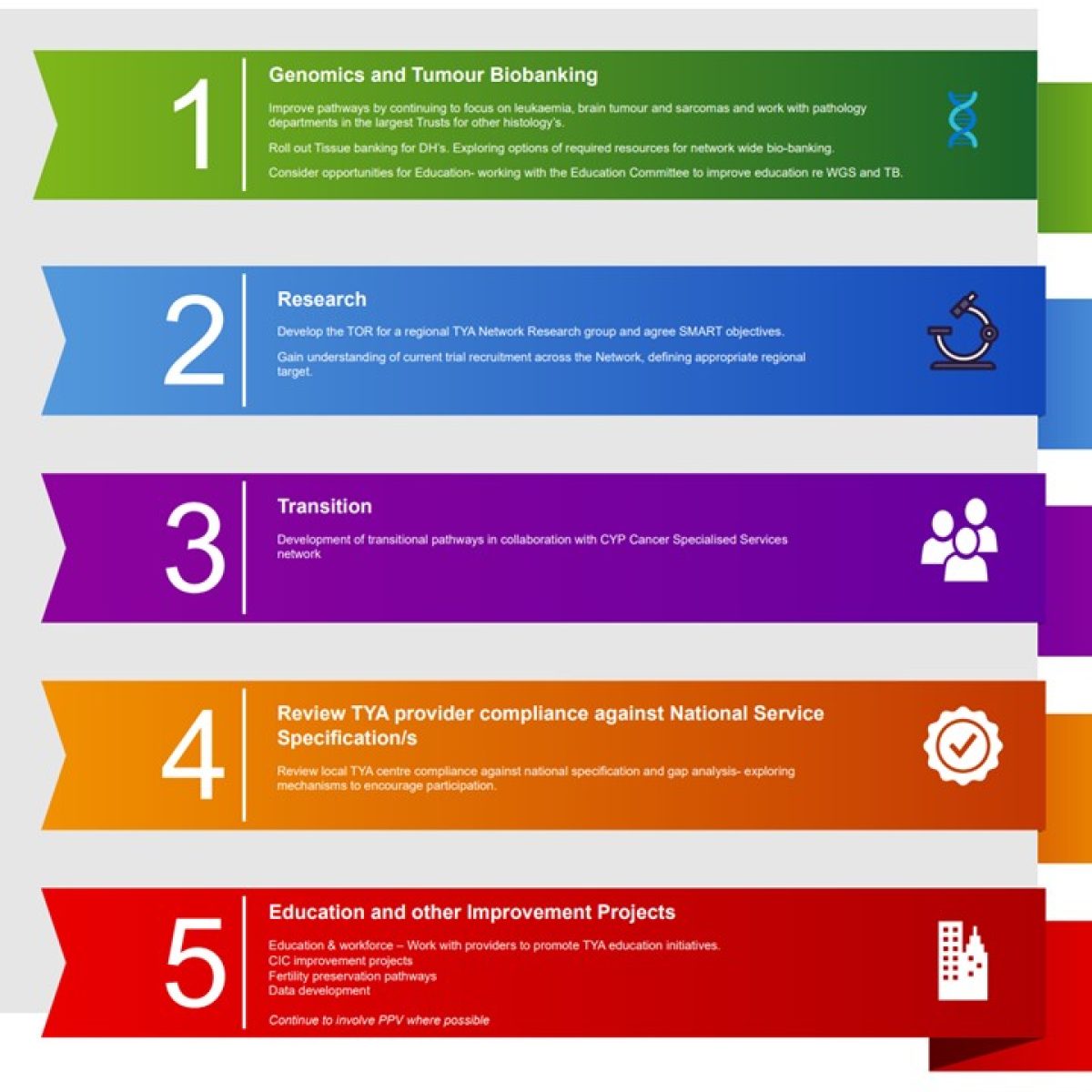
We continue to collaborate closely with the Northwest Children’s Network and the National CTYA networks. This is reflected in our 2025–26 workplan, where the transition from children’s to TYA services is identified as a key area for development.
In parallel, we are partnering with Cancer Alliances to drive forward a successful and impactful programme.
Workstream Lead: Hanna Simpson
PMO Lead: Laura Bayliff
Aims
- Review of current Workforce and Education Provision
- Stakeholder identification, including Patient and Public Voice
- Generation and implementation of recommendations for Workforce and Education
Highlights and Achievements of 2024-25
- Sponsored over 40 places at relevant study days and events.
- Sponsored posters and attendance at the Global AYA Congress in Australia.
- Collaborated with the Children and Young People’s Network, becoming joint members of the Florence Nightingale Foundation Academy and offering access to all Registered Nurses and Allied Health Professionals in our Networks.
- Developed a working group with membership from across the Network to continue the work on Education and Workforce into 2024/25
- Held the first joint North West Children’s and TYA Cancer Conference in 2024. The team welcomed 90 delegates from across the North West and further afield. 17 speakers delivered talks throughout the day and 10 exhibitor stalls raised awareness about local charities and organisations.
The 2025 conference is due to take place on 07 March 2025.
Forward into 2025-26
The Network plans to continue to collaborate with the cancer alliance workforce programmes to develop co-ordinated approach to system level workforce planning and facilitate the provision of expertise to the development of appropriate training, education, and professional development opportunities.
The Whole Genome Sequencing and Tumour Bio Banking Working Group
Workstream Lead: Professor Martin McCabe
Project Manager: Rachael Hastwell
The aim of the project is to embed genomic medicine and tumour biobanking into care pathways, making precise diagnosis and treatment plans, and inspiring future research to improve outcomes.
- Pathway identification and process mapping
- Review of current WGS and TB provision
- Stakeholder identification, including Patient and Public Voice
- First-level education and profile-raising activities
- Generation and implementation of recommendations for WGS and TB pathways across the Network
What is Genomic Sequencing?
Inside almost every cell of our body is a copy of the genome, made of DNA. The genome can be thought of as the instructions for running a cell. It tells the cell what kind of cell to be – is it a skin cell or a liver cell? It also has the instructions that tell the cell when to grow and divide, and when to die. When a cell divides to become two cells, this genome is copied. Usually, our cells divide to make new cells in a controlled way. This is how our bodies grow and repair. Sometimes when our cells divide, mistakes happen when copying the genome. They are caused by natural processes in our cells, or just by chance. The differences are called ‘variants’. These might be a single letter. Or a string of letters may be in a different place or missing. Whole genome sequencing will involve samples being taken, sent to a laboratory, run through a machine that ‘reads’ the DNA and a report will be returned to the clinical team with any relevant findings. As we share DNA with family, getting tested may have implications for other family members, so we may want to share that information with them and talk to them about what it might mean for them following the results.
Benefits of Genomic Sequencing
Results can provide information on:
- Genes that have not previously been looked at through routine testing
- Why a tumour or cancer developed
- What type of tumour or cancer the patient has and check that treatment is tailored to that cancer. There may be clinical trials looking for patients with specific genetic changes in their tumour
- Whether there is a gene presence which might increase the risk of developing other cancers in the future. This may lead to precautionary action or start screening for the cancer sooner
- Whether other family members may have a greater risk of developing cancer and are able to get tested or start screening early
Information Resources WGS for cancer patients
Highlights and Achievements of 2023-24
- Successfully appointed to the Clinical Pathway Project Manager post
- Established the WGS and TB Working Group
- Completed project brief and timelines.
- CPPM presented the project at cancer alliance meetings.
- Audit conducted and set to conclude in Q2.
Forward into 2025-26
An in-depth audit has completed across the Network. Focused engagement sessions will be timetabled to enable us to improve stakeholder relationships and support our goal of embedding genomic medicine within TYA Cancer Services.
Provider Service Review/Assurance
Workstream Lead: Dr Anna Castleton
PMO Lead: Rachael Hastwell and Laura Bayliff
The workstream is responsible for developing an assurance process against the Service Specification/s for Teenage and Young Adult providers. This includes all PTC (Principal Treatment Centres) and DH’s (Designated Hospitals) across the Network, ensuring equitable access.
Highlights and Achievements of 2023-24
- Developed two self-assessment tools, one for Principal Treatment Centres and one for Designated Hospitals
- Hosted a clinically led webinar to share our plans with members and receive feedback.
- Visited nine member hospitals, meeting with cancer and organisation leaders to discuss the TYA Network, Draft Service Specifications and our goals.
- Received returns from 15 Trusts, with over 1,000 data points.
- Delivered the Network-level analysis, local analysis, and future plans to all Trusts.
Forward into 2025-26
The Network plans to continue to offer designated hospitals support following their self-assessment results, to undertake objective setting and quality improvement for providers. The Network plans to review the assurance process that feeds into our Network Oversight Group.
Title TYA 2025-26 Work Plan